

The Ultimate Guide to Allowance for Kids
How to set up allowance, decide if it should connect to chores, and teach money habits, without turning every sock into a paycheck negotiation.

Your kid asks for a toy at the store. You say no. They ask if they can "earn money" for folding laundry. You say yes, but only this once. Next week they refuse to make their bed unless you pay up. Suddenly you're running a household where every sock has a price tag, and nobody feels good about it.
Allowance sounds simple until you try it. Should it connect to chores? How much is enough? What happens when they blow it all on gum on day one? The good news: you don't need a perfect system on day one. You need a clear model your family can explain in one sentence, and enough flexibility to adjust as your kid grows.
This guide walks through allowance vs rewards vs chore pay, age-based starting points, save, spend, and give frameworks, and when non-money rewards make more sense than cash. The goal isn't to raise a mini accountant. It's to build habits, responsibility, delayed gratification, and generosity, without turning family life into a contract negotiation.
Three models: allowance, rewards, and chore pay
Families often mix these up. Kids definitely do. Separating the models helps everyone know what they're earning and why.
Model 1: Allowance (learning money)
What it is: A regular amount of money, usually weekly, given to teach budgeting, saving, and spending choices.
What it's for: Practice with real money in low-stakes amounts. Kids learn that money is finite, that waiting can get you something bigger, and that giving feels good when it's their choice.
Typical setup: Allowance arrives on the same day each week whether or not the room is clean. Baseline family chores, making the bed, clearing dishes, putting laundry in the hamper, are expected: not paid. You might say: "Allowance is how you learn to manage money. Chores are how you help the family."
Best for: Ages 6 and up (sometimes 5 with very simple jars), when kids can count coins or understand simple addition and when you're ready to let them make small mistakes.
Model 2: Rewards (motivation and celebration)
What it is: Non-cash or small perks earned for effort, streaks, or completing quests, stars, screen time, choosing the movie, a special outing, extra playground time.
What it's for: Short-term motivation, especially for younger kids who don't yet care about dollars. Rewards reinforce habits before abstract money lessons land.
Typical setup: Complete daily quests, earn stars or points, trade them for rewards the family agreed on in advance. Rewards are predictable, not random bribes pulled out during a meltdown at Target.
Best for: Ages 3-8 (and honestly, sometimes older kids too for specific habit-building sprints). Pair with ideas from Best Reward Ideas for Kids so you're not stuck inventing prizes every Tuesday.
Model 3: Chore pay (extra jobs, extra cash)
What it is: Payment for specific tasks beyond baseline family responsibilities, washing the car, organizing the garage, weeding the garden, watching a younger sibling for an hour.
What it's for: Connecting work to income for kids who are ready to think like earners. Teaches that some labor has market value, without making bed-making a billable event.
Typical setup: A posted list of "extra jobs for pay" with clear rates. Baseline chores stay unpaid. Optional: a kid can propose a job ("Can I earn $5 for cleaning out the hall closet?") and you negotiate.
Best for: Ages 8 and up, or whenever your child asks how to earn money for something specific and can follow through on a multi-step job.
How the models work together
Most successful families use all three layers: but with bright lines:
| Layer | Example | Paid? |
|---|---|---|
| Baseline family jobs | Bed, dishes, pet feeding | No |
| Allowance | $5 every Saturday | Yes, fixed |
| Extra chore pay | Mowing, deep clean garage | Yes, per job |
| Stars and rewards | Streak bonus, quest complete | Non-cash perk |
When a seven-year-old asks, "Do I get money for this?" you can answer: "That's a family job. Extra jobs are on the fridge. Your allowance comes on Saturday."
Clear boundaries prevent the "paycheck negotiation" spiral, and keep chores connected to belonging: not only billing.
Age-based starting points
There's no single correct age to start allowance. Development matters more than the calendar. Use this as a map, not a mandate.
Ages 3-4: Rewards before money
Most preschoolers don't need cash. They need visible progress and immediate feedback.
- Use stars, stickers, or a simple chart for 1-2 daily helpers (toys away, placemat cleared).
- Rewards: choosing a story, baking together, "special time" with a parent, a small non-food treat.
- Introduce coins only as play, sorting, counting, without tying them to behavior yet.
For age-appropriate job ideas, see the early sections of the Ultimate Guide to Chores by Age.
Ages 5-6: Bridge to real money
Many families start here with tiny amounts and three clear jars: Save, Spend, Give.
- Allowance range: $2-$4 per week (adjust for your budget).
- Chores: 2-3 daily family jobs; payment optional and usually small if used at all.
- Focus: Naming coins, understanding "this OR that," giving a coin to a cause they choose.
If cash feels like too much too soon, stay on a star system and revisit allowance at six or seven.
Ages 7-9: Allowance as a habit
Weekly allowance becomes the default money lesson.
- Allowance range: Roughly $0.50-$1 per year of age per week ($3.50-$9).
- Chores: 3-4 daily tasks plus 1-2 weekly jobs; baseline unpaid, extra jobs optionally paid.
- Focus: Saving for a goal over 2-4 weeks, comparing prices, giving a set percentage.
This is also when kids start noticing fairness, "Why does my sister get more?" Keep explanations simple and consistent.
Ages 10-12: More autonomy, clearer contracts
Tweens can handle bank accounts (with you as joint owner), spreadsheets, or apps, and they will test boundaries.
- Allowance range: $5-$12+ per week, or a monthly lump sum for kids ready to budget longer.
- Chores: Larger share of household work; chore pay for big seasonal jobs.
- Focus: Needs vs wants, planning for gifts, small mistakes (buyer's remorse is educational).
Ages 13+: Toward real-world earning
Allowance often shifts toward covering specific categories, clothes, entertainment, outings, while teens earn extra through babysitting, lawn care, or family-approved side jobs.
- Allowance range: Enough to cover agreed categories, not unlimited spending.
- Chores: Treat baseline contributions as non-negotiable citizenship; pay only for true extras.
- Focus: Budgeting for months, charitable giving, saving for larger goals (phone, camp, car fund).
Teen chore expectations overlap with the older tiers in the Ultimate Guide to Chores by Age, allowance should match the responsibility level you expect, not fight it.
Should allowance be tied to chores?
This is the question every parent forum argues about. Both camps are partly right.
The case for separating allowance from chores
Pros:
- Chores stay framed as family membership: not optional work-for-hire.
- Allowance can be withheld for money mismanagement without turning chore strikes into wage disputes.
- Kids still learn money skills even on weeks when illness or travel disrupts routines.
- Avoids "I don't need money this week, so I won't do chores" logic.
Cons:
- Some kids need a stronger link between effort and outcome to stay motivated.
- Without any connection, allowance can feel like a handout rather than earned.
Works well when: You want chores to be non-negotiable and allowance to be a parallel life-skills curriculum.
The case for tying allowance to chores
Pros:
- Clear incentive for follow-through, especially for kids who respond to concrete rewards.
- Mirrors adult life: work often connects to income.
- Can simplify rules: "Complete your chore list by Sunday to get allowance."
Cons:
- Baseline tasks can become bargaining chips ("I'm not doing dishes unless you pay me").
- Sick days, busy weeks, and emotional rough patches turn into payment drama.
- Siblings with different abilities may need different chore loads but "equal" allowance, or unequal pay that feels unfair.
Works well when: Chores are truly optional extras, or when you use a hybrid: small fixed allowance plus bonuses for streaks or extra jobs.
A hybrid many families swear by
- Unpaid baseline chores everyone does because they live here.
- Fixed weekly allowance for money practice (not strictly performance-based, but can pause if baseline chores are refused for a full week, framed as "we don't fund fun money until basic responsibilities return," not as hourly wage theft).
- Paid extra jobs for motivated earners.
- Non-cash rewards for streaks and attitude, not every good deed needs a dollar.
Write your one-sentence family rule on the fridge. Example: "We all help at home. Allowance teaches money. Extra jobs pay extra."
If you're still building the chore side of the equation, Why Kids Should Do Chores explains the developmental why before you attach dollars to it.
Save, spend, give: frameworks that actually stick
Allowance without structure becomes pocket lint. These frameworks give kids somewhere to put money, and a reason to care.
The three-jar method (ages 5-10)
Three labeled jars or envelopes:
- Spend: Fun now, small toys, trading cards, app currency (if you allow it).
- Save: A named goal written on the jar, "LEGO set," "new book," "zoo trip."
- Give: Donations, gifts for others, church or community giving, kid chooses the cause when possible.
Split example: 50% spend, 40% save, 10% give, or 40-40-20 if giving matters a lot in your family.
Review jars weekly. Celebrate when Save fills up. Let Give be their choice within your values.
The four-bank method (ages 10+)
Add Invest or Future as a fourth category, college jar, phone fund, camp savings, or use a simple kids' savings account.
Some families move to monthly allowance on the 1st to mimic paycheck rhythm. Others stay weekly for tighter feedback loops.
Rules that reduce chaos
- Parent approval over a threshold. Purchases over $10 (or whatever fits) need a quick check-in, not to veto, but to ask "Still want it tomorrow?"
- No loans. Advancing next week's allowance teaches the wrong lesson about debt.
- Natural consequences. If Spend is empty, the store answer is "Your spend jar is empty. Want to move something from Save, or wait?" Empathy, not shame.
- Give before spend sometimes. On allowance day, drop the Give portion first so it doesn't get forgotten.
When kids "waste" money
They will. Cheap toys break. Candy disappears in minutes. Resist the lecture in aisle four.
Instead, later that week: "How did that feel? Worth it?" Most kids self-correct after one or two hollow purchases, if you don't refill Spend to rescue them from the lesson.
Screen time, privileges, and non-money rewards
Not every motivator should be monetary. Screen time, in particular, works best as a bounded privilege: not an auction item, unless you enjoy haggling over "five more minutes" until bedtime.
Screen time as a reward (carefully)
Works when:
- Rules are posted: "Quests done → 30 minutes tablet" or "Stars this week → movie night pick."
- Screen time isn't the only reward (variety prevents screen-only motivation).
- You can enforce the limit without a fight, timers, device settings, or a family charging station.
Gets messy when:
- Every chore has a minute price ("I'll unload dishes for 15 minutes Roblox").
- Kids negotiate mid-meltdown.
- Younger siblings can't earn the same way but want equal time.
Better pattern: complete baseline responsibilities first: then earned screen time opens. Screen time is the door that unlocks, not the currency for every sock.
Strong non-money rewards by age
Pull from a family menu so you're not inventing prizes under pressure. Our Best Reward Ideas for Kids post has a full list; highlights:
Younger kids: Choose dinner, stay up 15 minutes late, parent "date" to the park, sticker book, pick the family game.
Elementary: Friend playdate, special dessert, choose weekend activity, extra story chapter, "commander of the remote" for one show.
Tweens and teens: Later curfew on a weekend, solo trip to a favorite shop with a cap, skipping one chore they dislike (swap, don't erase responsibility), concert or event contribution.
Rotate rewards so novelty doesn't expire in week two.
Mixing money and non-money
A balanced week might look like:
- Saturday: allowance into jars.
- Daily: stars for quest completion.
- Weekly: if 5 of 7 daily quests done, pick a non-money reward from the menu.
- Monthly: optional paid big job for savers chasing a large goal.
Kids learn that value comes in different forms, and that reliability matters as much as a single heroic cleanup.
Setting up your system step by step
You don't need a perfect spreadsheet. You need a first version you can explain at dinner.
Step 1: Pick your model (write it down)
Choose: separated allowance, tied allowance, or hybrid. One sentence on the fridge.
Step 2: List baseline chores by age
Use the Ultimate Guide to Chores by Age to assign realistic daily and weekly jobs. Keep the list short enough to finish.
Step 3: Set the amount and payday
Pick a day (Saturday morning is popular). Same amount, same time, predictability beats surprise.
Step 4: Choose save, spend, and give splits and jars
Label them with your kid. Let them decorate. Ownership increases engagement.
Step 5: Add a reward menu (non-cash)
Five to ten options everyone agrees on. No last-minute junk food bribes unless that's genuinely your family culture.
Step 6: Optional extra-job list
Post rates for jobs you're willing to pay for. Ignore everything else.
Step 7: Review at 30 days
Ask: Are chores happening? Is allowance teaching anything? Are we fighting about money every week? Adjust one variable at a time.
Digital tools can help when paper charts die on the kitchen counter, especially if you want quests, streaks, and rewards in one place. For options that fit different ages and parenting styles, see Best Chore Apps.
Common mistakes (and gentler fixes)
Paying for baseline chores, then wondering why kids negotiate everything. Fix: Move baseline tasks to "family jobs." Pay only extras.
Inconsistent paydays. Fix: Set a phone reminder. Trust erodes when Saturday money arrives on Wednesday "sometimes."
Allowance so large there's nothing to want. Fix: Allowance should create choices, not cover every desire. Big goals take weeks of saving.
No giving category. Fix: Even 10% builds the muscle of generosity early.
Using allowance as punishment for every mistake. Fix: Separate behavior consequences from money lessons when possible. Losing allowance for being rude to a sibling blurs two different teachings.
Competing with impulse buys at checkout. Fix: "You can use your Spend jar" ends the debate. If Spend is empty, the answer is wait.
Expecting instant budgeting genius. Fix: You're planting seeds for a ten-year lesson, not launching a CFO.
Keeping chores and money from becoming a battlefield
Kids push boundaries. That's their job. Your job is to hold the model calmly.
When they refuse chores:
- Restate the family rule once.
- Consequence matches the layer: baseline chore refusal might mean no earned screen time or paused allowance, not a new fee for making a bed.
- Offer a reset: "Tomorrow we try again."
When they want more money:
- Point to the extra-job list.
- Encourage saving toward a goal with a date on the calendar.
- For older kids, discuss neighborhood earning (with safety rules).
When siblings compare:
- Acknowledge feelings. Explain age differences in chores and allowance if amounts differ.
- Avoid justifying with "because I said so" every time, one clear principle helps.
The emotional tone matters as much as the math. Allowance works best in homes where chores already mean we take care of each other: not you owe me.
Optional: stars, wishes, and a softer reward layer
Not every family wants cash in the mix at six, or wants cash to be the only motivator at ten. That's where a quest-and-reward layer sits alongside allowance.
Some families use stars for daily follow-through and keep allowance separate for money skills. Kids complete quests, bed, dishes, backpack, pet feeding, earn stars, and save stars toward wishes: choosing Saturday breakfast, a family bike ride, extra story time, or a small treat they picked in advance. The star is the immediate win; the wish is the horizon goal.
Tools like StarKid are built for that middle ground: chores become visible quests, progress accumulates as stars, and rewards (wishes) stay kid-chosen but parent-approved. Allowance can still run on Saturday in three jars. Stars handle Tuesday motivation when everyone is tired and nobody wants a lecture about compound interest.
The combination works because each layer does one job:
- Family chores → belonging.
- Allowance → money literacy.
- Stars and wishes → momentum and celebration.
You're not paying your kid to exist. You're giving them multiple ways to feel capable, and to see that effort connects to outcomes over time.
The long game
Allowance is less about the dollar amount than about repeated practice: waiting, choosing, giving, recovering from a dumb purchase, and showing up for family jobs when the money isn't the point.
Start small. Explain the model once, then enforce it boringly. Adjust at 30 days. Add chore pay when they ask for bigger goals. Keep baseline chores non-negotiable so your home doesn't run on tips.
Your kid will mismanage money. They will also surprise you, donating more than you expected, saving for a gift for a friend, or proudly buying something they planned for weeks. Those moments are the whole point.
Pick your model. Label the jars. Post the extra-job list if you want one. Then let the system be a little dull and a lot fair, the best kind of lesson for a kid who's still learning what a dollar actually means.
Frequently asked questions
Many families begin between ages 5 and 7 with a small weekly amount and clear save, spend, and give jars. Before that, non-cash rewards, stars, extra story time, choosing dinner, often work better than coins in a piggy bank.
Related articles
Best Reward Ideas for Kids
Reward ideas kids actually want, non-cash treats, experience rewards, and money-adjacent options that motivate without spoiling.
Read article →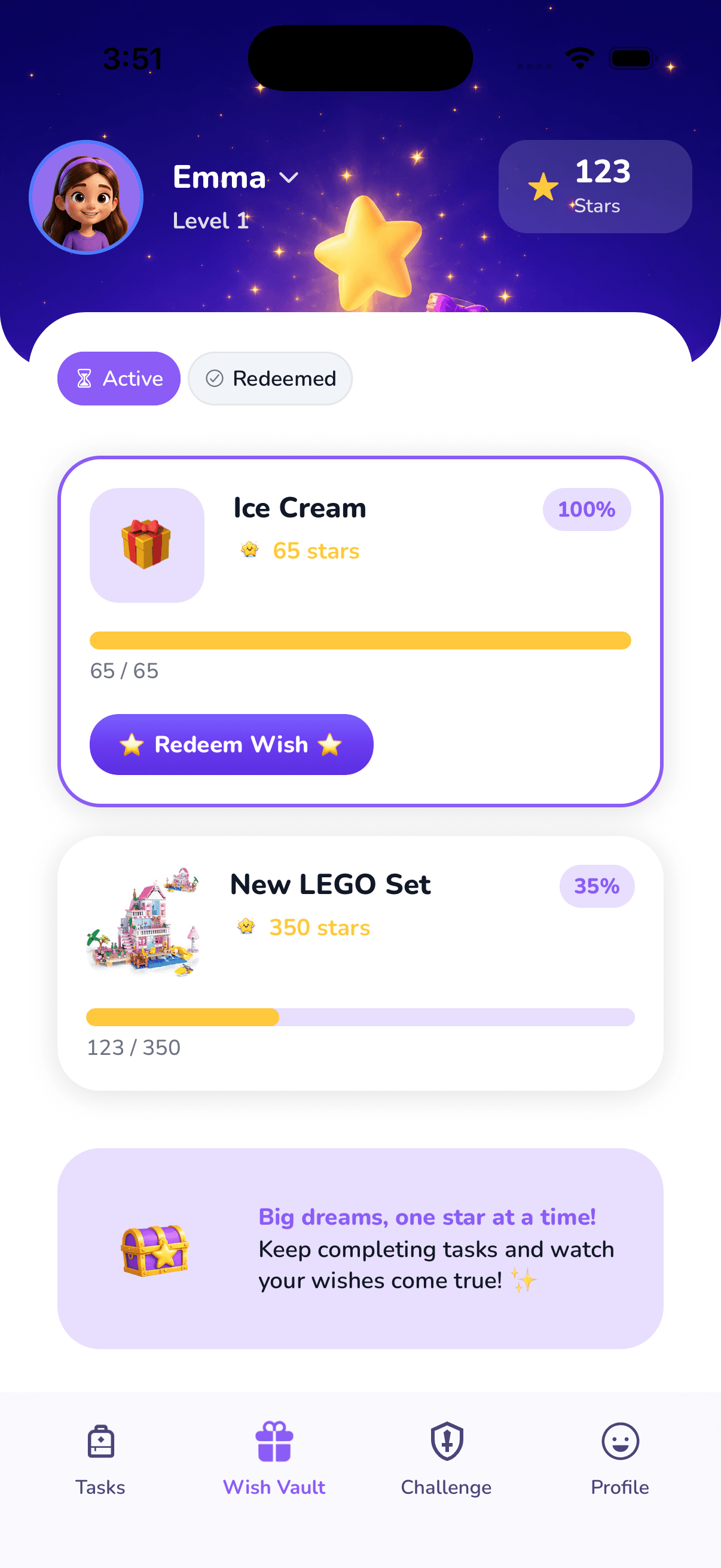
Best Chore Apps for Families
A fair comparison of family chore apps, checklists, points, allowance, and gamified quests, plus how to pick the right fit for your kids.
Read article →
The Ultimate Guide to Chores by Age
A complete, age-by-age chore system for kids, from toddlers to teens, with lists, tips, and how to make chores stick without yelling.
Read article →Ready to turn chores into adventures?
StarKid tracks chores, rewards, and streaks automatically—so your family builds habits without the daily battles.